Fractal Patterns in Prime Distribution: Chaos and Probability in Number Theory
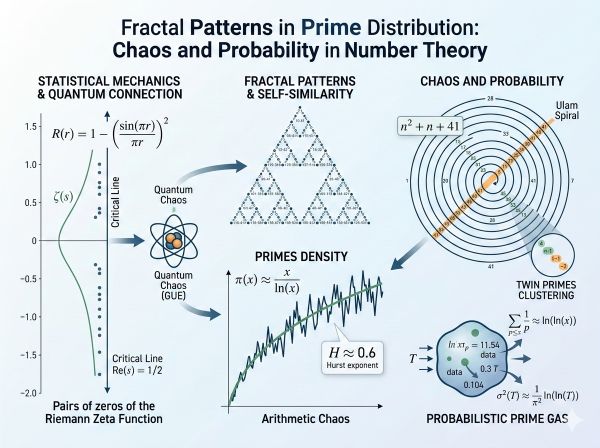
Fractal Patterns in Prime Distribution: Chaos and Probability in Number Theory
For millennia, the prime numbers—integers greater than 1 that have no divisors other than 1 and themselves—have stood as the "elementary particles" of mathematics. Yet, unlike the predictable behavior of atoms in a crystal, the appearance of primes along the number line seems at first glance to be the epitome of randomness. 2, 3, 5, 7, 11, 13, 17, 19... As one moves toward infinity, the primes appear to emerge with no apparent rhythm, a chaotic scattering that has frustrated the greatest minds from Euclid to Euler. However, modern research is revealing that this chaos is far from absolute. Beneath the surface of number theory lies a hidden, self-similar architecture that mirrors the fractal patterns found in nature and the statistical laws of physical systems.
The quest to understand this structure has led mathematicians to a profound realization: the distribution of prime numbers is not merely a matter of arithmetic, but a complex tapestry of statistical mechanics, chaos theory, and fractal geometry. By analyzing the "gaps" between primes and the fluctuations in their density, researchers are uncovering a structured, self-similar nature that provides a new lens through which to view the elusive Riemann Hypothesis.
The Prime Number Theorem and the Harmonic Landscape
The first step in understanding the structure of primes is acknowledging their average behavior. In the 19th century, Gauss and Legendre independently observed that the density of primes near a large number is approximately . This observation culminated in the Prime Number Theorem, which provides the asymptotic count of primes less than , denoted by :
However, the actual count of primes deviates from this smooth curve in a "jagged" manner. These fluctuations are the birthplace of prime number chaos. Bernhard Riemann, in his landmark 1859 paper, showed that these fluctuations are controlled by the zeros of the Riemann Zeta Function:
The Riemann Hypothesis posits that all non-trivial zeros of this function lie on a single "critical line" in the complex plane where the real part is exactly . If true, it implies that the primes are distributed as regularly as possible, with the "noise" or fluctuations never exceeding a specific bound proportional to .
Statistical Mechanics and the Quantum Connection
In the 1970s, a surprising connection was discovered between number theory and physics. Hugh Montgomery and Freeman Dyson realized that the statistical distribution of the zeros of the Riemann Zeta function exactly matches the distribution of eigenvalues of Random Matrices used to describe the energy levels of heavy nuclei in quantum mechanics. This is known as the GUE (Gaussian Unitary Ensemble) Hypothesis.
This suggests that the primes are "vibrating" according to a spectrum that mirrors a chaotic quantum system. In statistical mechanics, we look at the pair correlation function, which measures the probability of finding two zeros at a certain distance from each other. The formula for this correlation is:
This "repulsion" between zeros—where they avoid being too close to one another—is a hallmark of many natural systems, from the spacing of parked cars to the energy states of atoms. It reveals that the primes are not truly random but are correlated, much like particles in a liquid that maintain a certain structural order despite their motion.
Fractal Geometry: Self-Similarity Across Scales
One of the most exciting recent developments in prime research is the application of fractal analysis. Fractals are structures that exhibit self-similarity—the pattern looks the same whether you zoom in or zoom out. Mathematicians have applied the concept of the "fractal dimension" to the distribution of primes to see if they possess this recursive property.
By treating the primes as a point set on the number line, researchers have utilized the Hausdorff Dimension and Detrended Fluctuation Analysis (DFA) to study long-range correlations. They found that the "gaps" between primes (the distance between and ) exhibit power-law scaling, a signature of fractal systems. If we define the fluctuation of prime counts over a window of length , we observe:
where is the Hurst exponent. For truly random "white noise," . For primes, the exponent suggests a "persistent" behavior, meaning that a larger-than-average gap is statistically more likely to be followed by another large gap at a certain scale, creating a fractal-like clustering known as intermittency.
The Chaos of "Twin" Primes and Polignac's Conjecture
The structure of primes is perhaps most visible in the study of Twin Primes (primes like 11 and 13 that differ by exactly 2). While the overall density of primes thins out, the Twin Prime Conjecture suggests that there are infinitely many such pairs. In 2013, Yitang Zhang made a massive breakthrough by proving that there are infinitely many pairs of primes with a gap of less than 70 million.
This "clumping" of primes at small scales, juxtaposed with the vast "prime deserts" found at larger scales, creates a multi-fractal spectrum. A multi-fractal is a system that cannot be described by a single fractal dimension but requires a spectrum of dimensions. The distribution of primes is "dense" in some mathematical regions and "sparse" in others, mirroring the uneven distribution of matter in the universe or the turbulence of flowing water. This multi-fractality is governed by Singularity Spectra, often represented by the function , which quantifies the local scaling behavior of the prime density.
The Harmonic Series and Logarithmic Fluctuations
A surprising way to visualize prime fractals is through the harmonic series and its relationship to the natural logarithm. The divergence of the sum of reciprocals of primes:
shows that primes are "denser" than squares but "sparser" than any linear progression. When this data is mapped onto a spiral—often called the Ulam Spiral—geometric patterns and diagonal lines emerge. These lines are not accidental; they represent quadratic polynomials that are particularly rich in primes, such as Euler’s formula . The presence of these diagonals in a seemingly random spiral is a visual manifestation of arithmetic chaos—order emerging from a sea of apparent noise.
Approaching the Riemann Hypothesis via Statistical Physics
Modern researchers are now using techniques from Critical Phenomena to approach the Riemann Hypothesis. In physics, a system at a critical point (like water turning to steam) exhibits universal scaling laws and fractal fluctuations. Some theorists suggest that the "Critical Line" of the Zeta function is analogous to a phase transition in a 1D physical system.
If we treat the Riemann Zeta zeros as particles in a one-dimensional gas (a "Log-Gas"), we can apply the Boltzman Distribution to study their energy states. The "Energy" of a configuration of zeros is related to the logarithm of the distance between them. The fact that they stay on the critical line suggests a state of thermal equilibrium. A proof of the Riemann Hypothesis may eventually come not from traditional algebra, but from proving that this "prime gas" is stable and cannot undergo a "symmetry breaking" that would push a zero off the line.
The variance of the number of zeros in an interval of length follows a logarithmic law:
This extremely slow growth of variance is a sign of hyperuniformity, a state of matter that is halfway between a crystal and a liquid. It confirms that the primes are among the most organized "random" systems in the known universe.
Conclusion: The Recursive Heart of Numbers
The research into fractal patterns in prime distribution has fundamentally changed the philosophy of number theory. We no longer view primes as isolated, stubborn accidents of arithmetic. Instead, we see them as part of a universal structural language. They exhibit the same statistical signatures as the heavy elements in stars, the fractal branching of river deltas, and the chaotic fluctuations of the stock market.
By bridging the gap between the discrete world of integers and the continuous world of statistical mechanics, we are closer than ever to understanding the "music of the primes." The fractal nature of their distribution reminds us that even in the most basic building blocks of our logical world, there is a beautiful, recursive complexity—a structured chaos that suggests a deep, underlying unity in the laws of mathematics. As we continue to zoom into the number line, the primes continue to whisper a message of self-similarity, beckoning us toward a final proof of the Riemann Hypothesis and a complete map of the arithmetic landscape.