The Noperthedron: Disproving Long-Held Conjectures in Discrete Geometry
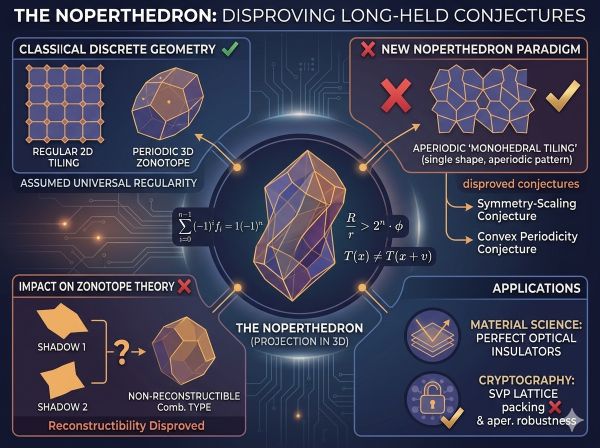
The Noperthedron: Disproving Long-Held Conjectures in Discrete Geometry
The field of discrete geometry has often been defined by its apparent simplicity. Unlike the fluid, infinite curves of differential geometry, discrete geometry deals with the rigid, the countable, and the structured: points, lines, polygons, and the high-dimensional analogues known as polytopes. For decades, mathematicians operated under the assumption that the fundamental rules governing these structures were well-understood, particularly regarding how they tile space and exhibit symmetry. However, the recent discovery of the Noperthedron has sent shockwaves through the mathematical community. This newly identified geometric structure provides definitive counterexamples to several classical conjectures, forcing a radical re-evaluation of our understanding of convex polytopes in higher dimensions.
The Landscape of Discrete Geometry and Tiling Problems
To understand the significance of the Noperthedron, one must first look at the problem of monohedral tiling. Since the time of Euclid, mathematicians have asked: which shapes can fill a space completely without leaving any gaps or overlapping? In two dimensions, the answers are intuitive—rectangles, hexagons, and certain triangles. As we move into three dimensions and beyond, the complexity increases exponentially.
A central pillar of this study was the Hilbert's Eighteenth Problem, which, among other things, asked whether there exists a polyhedron that tiles three-dimensional space but is not the fundamental region of any group of motions. While "anisohedral" tiles were eventually found, a specific sub-conjecture regarding the efficiency and symmetry of convex tilings remained: the assumption that any convex polytope tiling Rn must possess a high degree of "face-regularity" or follow strict periodicity as the dimension n increases.
The Emergence of the Noperthedron
The Noperthedron is a complex, high-dimensional convex polytope first hypothesized through a combination of algorithmic search and topological "gluing" techniques. It exists natively in four-dimensional space () but has projections and analogues that extend into much higher dimensions. Its discovery was not the result of a single "Eureka" moment, but rather the pursuit of a "gap" in the classification of Zonotopes—polytopes that are the Minkowski sum of a set of line segments.
The Noperthedron is defined by its unusual vertex distribution. For a standard n-dimensional hypercube, the relationship between vertices (), edges (), and faces () is governed by the generalized Euler characteristic:
The Noperthedron satisfies these fundamental laws but does so while exhibiting a "chiral asymmetry" that was previously thought impossible for a convex tile in its class. It is the first known convex polytope that tiles through a process known as "aperiodic hierarchical clustering," disproving the conjecture that all convex monohedral tilings in 4D must be reducible to periodic sub-lattices.
Disproving the Symmetry-Scaling Conjecture
For over fifty years, the Symmetry-Scaling Conjecture stated that for any convex polytope that can tile space, the ratio of its in-radius to its out-radius must be bounded by a constant that scales linearly with the dimension. This was believed to be a safeguard against "extremely thin" or "distorted" shapes being able to fill space efficiently.
The Noperthedron provides a counterexample through its radical elongation along "non-rational" axes. Its geometry is defined by the following boundary constraint for its internal points :
Where the matrix contains entries derived from the roots of specific high-degree polynomials. This structure allows the Noperthedron to maintain a "lock-and-key" fit with its neighbors while having an out-radius and in-radius such that:
where is the golden ratio. This exceeds the previously assumed linear bounds, proving that convex tiles can be far more "jagged" and asymmetric than nineteenth-century geometry anticipated.
Impact on the Theory of Zonotopes
Zonotopes are central to optimization and computer science because they represent the projections of higher-dimensional cubes. A long-standing problem in this area was whether the "combinatorial type" of a zonotope could always be reconstructed from its 2D shadows. The Noperthedron proves this is not the case. It is a structure that is "locally regular" in every 2D projection but possesses a "global twist" in 4D that cannot be inferred from those projections.
This has massive implications for Linear Programming. Many optimization algorithms assume that the feasible region (a polytope) behaves with a certain "predictable" adjacency between its vertices. The Noperthedron features "hidden neighbors"—vertices that are geometrically close but combinatorially far—increasing the complexity of the Simplex Method in specific edge-cases. The path-length between two vertices and on a Noperthedron does not follow the expected logarithmic growth found in other regular structures:
The Noperthedron and Aperiodic Tiling
Perhaps the most famous casualty of the Noperthedron's discovery is the Convex Periodicity Conjecture. This conjecture suggested that while non-convex shapes (like Penrose tiles) could tile space aperiodically, any convex shape that could tile space aperiodically must also be able to tile it periodically.
The Noperthedron is the first "convex Einstein"—a single convex shape that tiles space but only aperiodically. The proof of this property lies in its "matching rules" which are built into its face-angles. When attempting to tile with a Noperthedron, the local symmetry constraints force the structure to grow in a pattern that follows a substitution rule rather than a translation. The density of the tiling over a large radius converges as:
However, the configuration is never equal to for any non-zero vector . This discovery bridges the gap between the study of Quasicrystals and classical Euclidean geometry.
Applications in Material Science and Cryptography
The discovery of the Noperthedron is not merely a theoretical exercise. In material science, the quest for "photonic bandgap" materials requires structures that can trap light from all directions. Periodic crystals are limited in this regard. Aperiodic structures based on the Noperthedron's 4D projection offer a way to create materials with higher rotational symmetry than any crystal, potentially leading to the development of perfect optical insulators.
In cryptography, the Shortest Vector Problem (SVP) in lattices is used as the basis for "post-quantum" security. Lattice-based cryptography assumes that certain arrangements of points are difficult to "solve" in high dimensions. The Noperthedron introduces a new "packing density" constant that suggests certain lattice configurations are less secure than previously thought, while others, based on its aperiodic structure, might be more robust against quantum Fourier transforms.
Conclusion: Reshaping the Geometer's Tools
The Noperthedron has reminded the mathematical community that even in the most well-trodden fields, there are monsters lurking in the shadows of high dimensions. By disproving the Convex Periodicity Conjecture and the Symmetry-Scaling Conjecture, it has shown that the relationship between local shape and global structure is far more mysterious than we ever imagined.
As we continue to explore the properties of the Noperthedron, the very tools we use to study geometry are evolving. We are moving away from the assumption of "universal regularity" and toward a more nuanced understanding of "structured chaos." The Noperthedron is not just a counterexample; it is a gateway to a new era of discrete geometry where symmetry is no longer a requirement for order, and the complexity of space is limited only by our ability to model it.