Zero-Knowledge Proofs: New Cryptographic Paradigms Inspired by Gödel
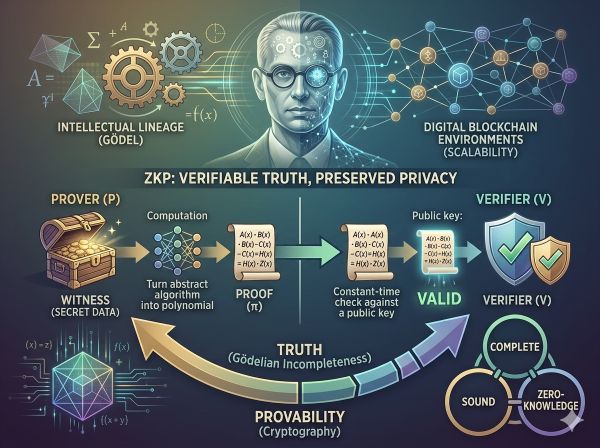
Zero-Knowledge Proofs: New Cryptographic Paradigms Inspired by Gödel
In the digital age, the fundamental tension between transparency and privacy has become a primary bottleneck for the evolution of the internet. As blockchain environments and decentralized finance (DeFi) scale, the need to verify the truth of a statement without exposing the sensitive data behind it has birthed a revolutionary cryptographic field: Zero-Knowledge Proofs (ZKPs). While modern ZKPs are cutting-edge software engineering marvels, their intellectual lineage traces back to the very foundations of mathematical logic, specifically the epoch-defining work of Kurt Gödel. By investigating the limits of what can be proven and what can be known, mathematicians have developed a paradigm that allows for absolute trust in a digital environment without the need for absolute exposure.
The Gödelian Spark: Truth vs. Provability
To understand the "Zero-Knowledge" paradigm, one must first look at Kurt Gödel’s Incompleteness Theorems. In 1931, Gödel shattered the mathematical world by proving that in any consistent axiomatic system, there are truths that cannot be proven within that system. This established a critical distinction between Truth and Provability. It suggested that the "knowledge" of a truth could exist independently of the formal "steps" used to reach it.
In cryptography, ZKPs take this concept a step further. If Gödel showed that some things are true but unprovable, Zero-Knowledge protocols show that some things can be proven to be true without revealing why they are true. In a ZKP system, a "Prover" () convinces a "Verifier" () that a statement is correct without sharing any information beyond the validity of the statement itself. This mirrors the meta-mathematical realization that information can be compartmentalized: we can verify the outcome of a logical process without auditing every internal state of that process.
The Mathematical Anatomy of a Proof
At its mathematical core, a Zero-Knowledge Proof is not a simple calculation but a probabilistic interaction. For a protocol to be considered "Zero-Knowledge," it must satisfy three fundamental properties:
- Completeness: If the statement is true, an honest Prover will always be able to convince the Verifier.
- Soundness: If the statement is false, no cheating Prover can convince the Verifier (except with an infinitesimally small probability).
- Zero-Knowledge: If the statement is true, the Verifier learns nothing other than the fact that the statement is true.
The mathematical representation of these properties often involves Elliptic Curve Cryptography (ECC) and Polynomial Commitments. For instance, in a common type of ZKP known as a zk-SNARK (Zero-Knowledge Succinct Non-Interactive Argument of Knowledge), the problem is converted into a Quadratic Arithmetic Program (QAP). The statement to be proven is turned into a polynomial equation of the form:
In this equation, the polynomials , , and represent the logic of the computation. The Prover demonstrates knowledge of a "witness" (the secret data) by showing they know a polynomial that fits this structure, without ever revealing the coefficients of the polynomials that represent the secret data itself.
From Logic to Digital Blockchain Environments
The transition of ZKPs from theoretical logic to blockchain environments has been driven by the need for privacy-preserving scalability. In a standard blockchain like Bitcoin or Ethereum, every transaction is public. If User A sends funds to User B, the entire world can see the addresses and the amounts. This is "Total Knowledge."
Modern protocols like Zcash or Ethereum's Layer-2 scaling solutions (zk-Rollups) utilize ZKPs to hide these details. Instead of recording the raw transaction data on the main chain, the system records a "Proof." The mathematics of the proof guarantees that the transaction is valid—meaning the sender had enough balance and the digital signature was correct—without the blockchain ever seeing the sender’s balance or the recipient’s address.
The efficiency of these proofs is measured by their "succinctness." In a zk-SNARK, the proof size is very small (a few hundred bytes), and the verification time is nearly constant, regardless of the complexity of the underlying computation. This allows a single proof to represent the validity of thousands of transactions, drastically increasing the throughput of the network.
The Interactive Paradigm: Fiat-Shamir Heuristic
Originally, ZKPs required multiple rounds of interaction between the Prover and Verifier, much like a game of 20 Questions. However, for blockchain use, proofs must be "Non-Interactive." This is achieved through the Fiat-Shamir Heuristic, which replaces the Verifier's random challenges with a cryptographic hash of the Prover's initial message.
Mathematically, if the Prover sends a commitment , instead of waiting for a random challenge from the Verifier, they compute:
where is a cryptographically secure hash function. This makes the proof "static," allowing it to be broadcast and verified by anyone at any time, effectively turning the proof into a digital certificate of truth that is independent of time and space, much like a mathematical theorem.
Privacy-Preserving Protocols and Gödelian Uncertainty
ZKPs represent a shift toward a "trustless" society where we rely on mathematical certainty rather than institutional reputation. By utilizing Gödelian-inspired logic, we can build systems that are simultaneously perfectly transparent (in their rules) and perfectly private (in their data).
Consider the application of ZKPs in identity verification. Using a protocol inspired by the Schnorr Identification Scheme, a person could prove they are over 18 years old without revealing their birth date. The mathematical statement would look like:
where is the secret (the birth date) and is the public proof. The difficulty of the Discrete Logarithm Problem ensures that while is easy to verify, is impossible to reverse-engineer. This creates a digital environment where sensitive data is never "in flight," reducing the risk of mass data breaches and centralized surveillance.
Conclusion: The Future of Known Truths
The evolution of Zero-Knowledge Proofs from the abstract incompleteness of Gödel to the high-stakes world of blockchain finance is a testament to the power of foundational mathematics. As we move deeper into an era dominated by artificial intelligence and decentralized networks, ZKPs will serve as the "logical armor" for our digital identities. They allow us to exist in a world where we can be certain of the truth without being vulnerable to its exposure. By grounding privacy in the unyielding laws of mathematics, we are not just building better databases; we are creating a new cryptographic paradigm where trust is a function of logic, not a leap of faith.