Modernizing Wind Turbine Theory: Mathematical Models for Renewable Energy
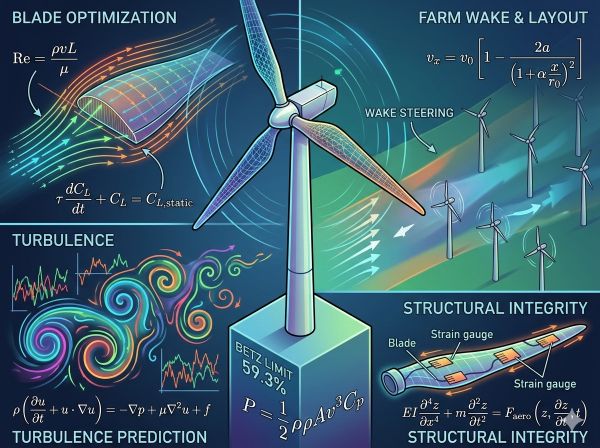
Modernizing Wind Turbine Theory: Mathematical Models for Renewable Energy
The transition toward a sustainable, carbon-neutral global economy has placed wind energy at the forefront of the renewable revolution. As turbines grow in size—with offshore giants now reaching heights comparable to skyscrapers—the engineering challenges associated with their design have moved beyond simple mechanical intuition. Modernizing wind turbine theory requires a sophisticated mathematical framework capable of describing the chaotic behavior of the atmosphere and the intricate aerodynamics of rotating blades. By utilizing advanced Partial Differential Equations (PDEs), researchers are now able to optimize blade geometry and predict turbulence with unprecedented accuracy, directly contributing to the efficiency and longevity of green energy systems.
The Betz Limit and the Foundation of Wind Power
To understand modern advances, one must first recognize the fundamental mathematical constraint on all wind energy extraction: the Betz Limit. Derived in 1919 by Albert Betz, this limit defines the maximum possible efficiency of a wind turbine. Using a simple 1D actuator disk model, Betz showed that no turbine can capture more than of the kinetic energy in the wind.
The power extracted from the wind is given by the equation:
where is the air density, is the swept area of the rotor, is the wind velocity, and is the power coefficient. The goal of modern mathematical modeling is to push the operational as close to the Betz limit as possible across a wide range of atmospheric conditions.
Advanced Aerodynamics: The Navier-Stokes Challenge
At the heart of turbine optimization lies the Navier-Stokes equations, the fundamental PDEs governing fluid flow. These equations describe how the velocity field and pressure of the air change as it interacts with the rotating blades. For an incompressible fluid, the equations are written as:
In the context of wind turbines, the "source term" represents the aerodynamic forces exerted by the blades. Solving these equations is computationally expensive because of the high Reynolds numbers associated with giant turbines. The Reynolds number is defined as:
where is the chord length of the blade. At high Reynolds numbers, the flow becomes turbulent, creating tiny vortices that drain energy and cause structural fatigue. Modern models use Large Eddy Simulation (LES) to solve the Navier-Stokes equations for the largest scales of motion while modeling the smaller, more chaotic scales using sub-grid scale mathematical closures. This allows engineers to see exactly how a blade tip vortex forms and how it affects the next turbine in the array.
Blade Element Momentum (BEM) Theory Modernization
While Navier-Stokes provides high fidelity, Blade Element Momentum (BEM) Theory remains the workhorse for turbine design. BEM divides the blade into several small "elements" and calculates the local lift and drag. However, classical BEM assumes steady-state conditions, which rarely exist in the field.
Modernization involves adding dynamic stall models and Prandtl's tip loss corrections to the standard equations. The lift coefficient is no longer treated as a static variable but as a differential equation that accounts for the "memory" of the flow:
This differential approach allows for the prediction of transient loads during gusts. By integrating these refined BEM models into real-time control systems, turbines can pitch their blades in milliseconds to mitigate sudden forces, reducing structural weight and increasing the potential for larger rotor diameters.
Turbulence Prediction and Wake Modeling
A single wind turbine does not exist in a vacuum. In a large wind farm, the "wake" of the upstream turbine reduces the energy available to those downstream and increases turbulence. This is known as the Wake Effect. Predicting the recovery of the velocity deficit in the wake is critical for farm layout optimization.
One of the most effective modern models is the Jensen Model, which assumes a linear expansion of the wake. The velocity at a distance downstream is modeled as:
where is the axial induction factor and is the entrainment constant. Advances in Stochastic Differential Equations (SDEs) are now used to simulate the "meandering" of these wakes caused by atmospheric instability. By modeling the wake as a dynamical system, farm operators can utilize "wake steering"—intentionally misaligning the upstream turbine to the wind to move the wake away from downstream rotors, increasing total farm energy output by up to to .
Structural Dynamics and Aeroelasticity
As blades become longer (exceeding 100 meters), they become highly flexible. The mathematical model must couple the aerodynamics (fluid) with the structural dynamics (solid), a field known as Aeroelasticity. This is described by a system of coupled PDEs. The displacement of the blade can be modeled using the Euler-Bernoulli beam equation, coupled with aerodynamic forces:
Solving these coupled equations prevents a phenomenon known as flutter—unstable oscillations that can lead to catastrophic blade failure. Modern mathematical breakthroughs in Reduced Order Modeling (ROM) allow these complex aeroelastic simulations to run in a fraction of the time, enabling "digital twin" technology. A digital twin is a real-time mathematical mirror of a physical turbine that predicts maintenance needs before a part actually breaks.
Optimization Through Genetic Algorithms
Finally, mathematics is used to find the "perfect" blade shape. This is an optimization problem where the objective is to maximize the Annual Energy Production (AEP) while minimizing cost and noise. Because the design space is multi-dimensional and "non-convex" (meaning it has many local peaks), researchers use Genetic Algorithms and Adjoint-based Optimization.
The adjoint method allows designers to calculate the "sensitivity" of the turbine efficiency to thousands of small changes in blade shape simultaneously. If is the efficiency, the gradient is calculated by solving an auxiliary Adjoint PDE. This mathematical shortcut has reduced the time required for blade design from months to days, leading to the rapid iteration of the highly efficient, curved blade tips seen in the latest turbine models.
Conclusion: The Mathematical Future of Green Energy
Modern wind turbine theory is no longer just about catching the wind; it is about the precise mathematical manipulation of fluid-structure interactions. By mastering the Navier-Stokes equations, refining BEM theory, and applying stochastic wake models, mathematicians and engineers are breaking the barriers of renewable energy efficiency. These advanced models directly impact the bottom line of green energy by lowering the Levelized Cost of Energy (LCOE), making wind power not just a moral choice, but the most economic choice for the planet's future.
As we move toward even larger floating offshore turbines and vertical-axis designs, the complexity of the math will only increase. The continued modernization of these mathematical models remains the silent engine driving the global transition to renewable energy.