Advances in Hyperbolic Geometry: Spectral Gaps and Friedman-Ramanujan Functions
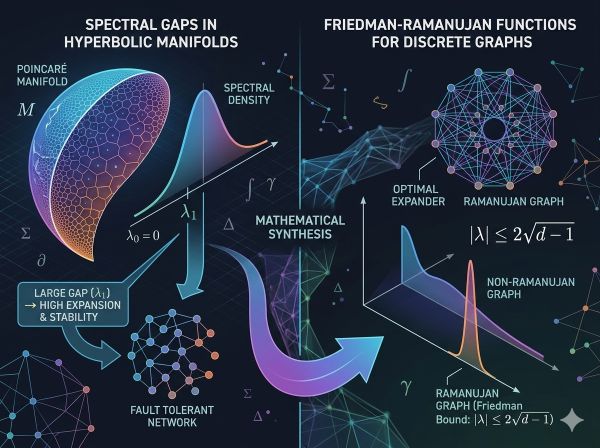
The study of hyperbolic geometry and spectral theory has long been a cornerstone of mathematical physics and network topology. In recent years, a synthesis of these fields has emerged, providing profound insights into the stability and efficiency of high-dimensional networks. At the heart of this revolution are the concepts of spectral gaps and the behavior of Friedman-Ramanujan functions. These mathematical constructs do more than fill textbooks; they define the limits of how information propagates across complex systems, from the global internet to the structural manifolds of general relativity.
Advances in Hyperbolic Geometry: Spectral Gaps and Friedman-Ramanujan Functions
To understand the stability of any complex network, we must look at its underlying geometry. Hyperbolic geometry, characterized by constant negative curvature, offers a unique environment where the "volume" of space grows exponentially with the radius. This property makes hyperbolic manifolds the ideal models for expansive networks. However, the true measure of a network's robustness lies in its spectrum—the set of eigenvalues derived from its Laplacian operator. Recent findings in the spectral theory of manifolds have highlighted the critical role of the spectral gap, the distance between the first and second eigenvalues of the Laplacian, in determining the expansion properties of high-dimensional systems.
The Spectral Gap: A Measure of Connectivity
In spectral geometry, the Laplacian operator acts as a tool to measure the smoothness and connectivity of a manifold or graph. For a closed hyperbolic manifold , the eigenvalues represent the "vibrational modes" of the space. The first non-zero eigenvalue, , is the spectral gap.
A large spectral gap implies that the manifold is a "good expander." In practical terms, this means that the system is highly interconnected; it is difficult to partition the network into two large, isolated components without cutting a significant number of edges or volume. The relationship between the geometric bottleneck of a manifold (the Cheeger constant ) and the spectral gap is given by the Cheeger inequality:
Recent breakthroughs have focused on the "Selberg 1/4 Conjecture," which posits that for certain arithmetic hyperbolic surfaces, the spectral gap is always at least . Proving this (or approaching it) has massive implications for the stability of high-dimensional networks, as it guarantees a minimum level of diffusive efficiency regardless of the network's size.
Friedman-Ramanujan Functions and Graph Expansion
While manifolds provide a continuous framework, Graph Theory offers the discrete analog necessary for digital network analysis. Here, the focus shifts to Ramanujan graphs—regular graphs where the spectral gap is as large as possible. A -regular graph is Ramanujan if every eigenvalue (other than ) satisfies the bound:
The discovery of Friedman-Ramanujan functions has revolutionized this field. Joel Friedman’s work proved that "almost all" regular graphs are "almost" Ramanujan. The functions describe the distribution of the second largest eigenvalue in a random -regular graph as the number of vertices tends toward infinity. This finding is crucial for high-dimensional network design: it suggests that if we build a large network randomly, it will inherently possess the expansion properties required for rapid synchronization and fault tolerance.
The stability of a high-dimensional network is directly tied to these spectral properties. In a system governed by a Friedman-Ramanujan distribution, the "mixing time"—the time it takes for a random walk to reach a uniform distribution—is minimized. This ensures that information, or load, is distributed evenly across the network, preventing "hotspots" that could lead to systemic failure.
Expansion Properties and Network Stability
Why does hyperbolic geometry favor expansion more than Euclidean geometry? In Euclidean space, the volume of a sphere grows polynomially: . In hyperbolic space, it grows exponentially: . This exponential growth means that most of the "mass" of a hyperbolic network is located at its boundary.
In high-dimensional networks, this creates a phenomenon known as the concentration of measure. Because the space is so expansive, any two random subsets are likely to be very close to each other in terms of graph distance. New findings show that spectral gaps in these high-dimensional hyperbolic manifolds act as stabilizers. If a node or a set of edges is removed, the spectral gap ensures that the rest of the manifold retains its "integrity." The expansion properties prevent the formation of "isolated islands," which is a primary requirement for the resilience of decentralized infrastructures like blockchain or global telecommunication grids.
The Role of Trace Formulas and Oscillatory Integrals
The mathematical verification of these spectral gaps often involves the Selberg Trace Formula. This formula creates a bridge between the "length spectrum" (the lengths of closed geodesics in the hyperbolic manifold) and the "eigenvalue spectrum" (the Laplacian eigenvalues). It is expressed as a sum over the eigenvalues balanced by a sum over the periodic orbits:
By analyzing the oscillatory integrals within the trace formula, mathematicians can determine if a manifold possesses "trapped" geodesics. If geodesics are trapped, the spectral gap narrows, and network stability decreases. Recent advances in Friedman-Ramanujan analysis have applied these trace formula techniques to discrete graphs, allowing us to predict the stability of a network purely by its topological signature before a single packet of data is even sent.
Applications in High-Dimensional Physics
The implications of these geometric findings extend into the realm of general relativity and quantum gravity. In Anti-de Sitter (AdS) space, which is a hyperbolic-like manifold used in string theory, the spectral gap of the gravitational Laplacian determines the "mass gap" of the dual conformal field theory. A stable spectral gap in the geometry ensures a stable, predictable vacuum state in the physics.
Furthermore, in the study of Manifold Learning—a branch of machine learning—researchers use hyperbolic geometry to embed hierarchical data. Because the Friedman-Ramanujan bound guarantees optimal expansion, hyperbolic embeddings allow for lower-dimensional representations of complex data without losing the "relational distance" between points. This makes the processing of high-dimensional datasets both faster and more stable against noise.
Conclusion: A Unified Theory of Expansion
The convergence of hyperbolic geometry, spectral theory, and Ramanujan functions is providing a unified framework for understanding expansion. We now know that the stability of a system—whether it is a physical manifold or a digital network—is a direct consequence of its spectral gap. As we continue to build increasingly complex, high-dimensional networks, the lessons from Friedman and Ramanujan serve as our guide: to ensure stability, we must embrace the expansive, interconnected nature of hyperbolic space.
The mathematical "needle" has moved from simply proving these gaps exist to engineering them. In the future, "Spectral Gap Engineering" will likely be a standard requirement for any critical infrastructure, ensuring that our networks are as resilient as the hyperbolic geometries upon which they are modeled.