Geometric Langlands Conjecture: The Massive Collaborative Proof
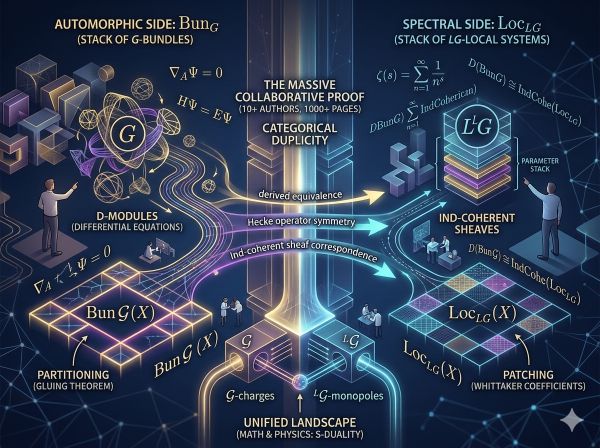
The following article details the 2024 completion of the proof for the Geometric Langlands Conjecture. This achievement represents a monumental shift in 21st-century mathematics, moving from the study of numbers to the study of categories, and providing a unified framework for algebraic geometry and representation theory.
The Geometric Langlands Conjecture: A Massive Collaborative Proof
In the history of mathematics, few visions have been as far-reaching as the Langlands Program. Proposed by Robert Langlands in 1967, it sought to build a bridge between number theory and harmonic analysis. While the "Arithmetic" version of this program remains one of the greatest challenges in science, its sibling—the Geometric Langlands Conjecture (GLC)—has finally been conquered. In a collaborative effort spanning decades and culminating in a 1,000-page proof, a global team led by Dennis Gaitsgory and Jacob Lurie has unified the worlds of algebraic curves and quantum symmetry.
The transition from arithmetic to geometry allowed mathematicians to replace discrete integers with continuous shapes. Instead of looking for solutions to polynomial equations in prime fields, they began studying sheaves and D-modules on Riemann surfaces. This shift provided the "missing language" needed to prove that the deepest symmetries of algebra are mirrored perfectly in the geometry of space.
The Duality of Stacks
The GLC is fundamentally a statement of categorical equivalence. It asserts that two vastly different mathematical structures, associated with an algebraic group and its Langlands dual group , are identical in their internal logic. This duality exists between two "stacks"—complex, high-dimensional spaces that parameterize geometric objects.
The two sides of the correspondence are:
- The Automorphic Side: This consists of the category of D-modules (systems of differential equations) on the stack of -bundles, denoted as .
- The Spectral Side: This consists of the category of ind-coherent sheaves on the stack of -local systems, denoted as .
The breakthrough proof establishes the following fundamental isomorphism:
This formula indicates that the way functions vary over a space of bundles is exactly mirrored by the way geometric "sheaves" sit atop the space of local systems.
The Role of Derived Algebraic Geometry
The primary difficulty in proving the GLC lay in the "singularities" of these stacks. In traditional geometry, a space with sharp corners or self-intersections is difficult to analyze. The stacks involved in the Langlands program are not just singular; they are infinite-dimensional. To navigate this, the team utilized Derived Algebraic Geometry, a field pioneered largely by Jacob Lurie.
In this framework, the standard rings of functions are replaced by simplicial commutative rings. This allows mathematicians to "resolve" singularities by adding higher-order information that "smooths out" the space. By working in the derived setting, the team ensured that the Hecke operators—mathematical symmetries that act like "shuffling" tools—commute correctly across the entire category. Without this "derived" perspective, the equivalence would collapse at the most critical points of the algebraic curve .
A Paradigm of Collaboration: The "Team of Ten"
The proof of the GLC is notable for being a massive collaborative effort. The complexity of the problem was such that no single mathematician could master every required sub-discipline. The project involved ten primary authors and a wider circle of researchers who spent over 20 years formalizing the necessary definitions.
The proof relies on the Gluing Theorem, which allows the correspondence to be verified on small patches of the curve and then mathematically "glued" together. This process requires ensuring that the Whittaker coefficients—a tool used to measure the "size" of an automorphic form—match the geometric data on the spectral side. The sheer scale of the 1,000-page document reflects the rigorous bookkeeping required to ensure that this gluing is consistent across all dimensions.
Physical Echoes: S-Duality and String Theory
Perhaps the most startling aspect of the GLC proof is its resonance with Theoretical Physics. In the early 2000s, it was discovered that the Geometric Langlands correspondence is a mathematical shadow of S-duality in 4D super-symmetric gauge theory.
In this physical context, the side represents electric charges, while the side represents magnetic monopoles. S-duality suggests that a theory with strong electric coupling is identical to a theory with weak magnetic coupling. The completion of the GLC proof provides the rigorous mathematical backbone for this "Mirror Symmetry," proving that the laws of Quantum Field Theory are deeply embedded in the structures of algebraic geometry.
Beyond the Proof: The Arithmetic Future
With the "Geometric" case now considered a theorem, the focus of the mathematical world is shifting back to Arithmetic Langlands. The tools developed for the GLC—specifically the use of Higher Category Theory and infinity-categories—are being adapted to study number fields like the field of rational numbers .
If these categorical methods can be successfully "arithmetized," it could lead to a resolution of the Reciprocity Conjecture. This would allow us to understand the behavior of -functions, such as the Riemann Zeta Function:
in a way that links their zeros directly to geometric symmetries. This is the ultimate prize of the Langlands Program: a complete dictionary between the continuous and the discrete.
Conclusion: The Unified Landscape
The completion of the Geometric Langlands proof is more than just the solution to a conjecture; it is the construction of a new continent in the world of mathematics. We now have a verified, rigorous path connecting differential equations, algebraic shapes, and the fundamental symmetries of physics. The "Massive Collaborative Proof" stands as a testament to what the mathematical community can achieve through shared language and persistent, collective effort. The bridge is built, and the exploration of the lands it connects has only just begun.