Interdisciplinary Trends: Mathematics in Climate Resilience and Economic Policy
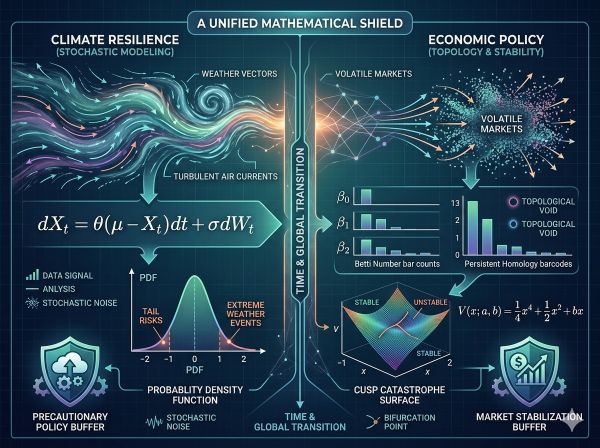
Interdisciplinary Trends: Mathematics in Climate Resilience and Economic Policy
The modern era is characterized by a state of "polycrisis"—a convergence of ecological instability and economic volatility that defies traditional linear modeling. As global temperatures rise and financial markets become increasingly interconnected, the need for a unified mathematical language to describe these systems has never been more urgent. Two fields that were once considered distinct—climatology and macroeconomics—are now finding common ground through the application of stochastic modeling and topological data analysis (TDA). These mathematical frameworks are no longer just academic curiosities; they are the essential tools required to predict extreme weather events and stabilize markets during the volatile global transitions of the 21st century.
The Stochastic Nature of Climate Resilience
Predicting the climate has traditionally relied on deterministic models—massive sets of differential equations that simulate the atmosphere and oceans. However, the inherent "chaos" of the climate system means that small uncertainties in initial conditions can lead to vastly different outcomes. To build true climate resilience, mathematicians are shifting toward stochastic differential equations (SDEs). These equations incorporate "noise" as a fundamental component of the system, rather than an error to be eliminated.
A primary model used to predict the temperature fluctuations of a specific region involves the Ornstein-Uhlenbeck process, which accounts for mean-reverting behavior while acknowledging random shocks. The state of the system is governed by:
where represents the rate of reversion to the mean , and represents the stochastic "Wiener process" or Brownian motion of atmospheric noise. By solving these SDEs across high-dimensional space, researchers can move from predicting a single weather event to calculating the probability density function (PDF) of extreme heatwaves or floods. This probabilistic approach allows governments to design infrastructure that is resilient not just to the "average" storm, but to the statistical "tail risks" that were previously ignored.
Topology and the Shape of Financial Volatility
While stochastic calculus handles the "noise" of climate and markets, Topology—the study of shapes and their properties under continuous deformation—is being used to detect the "signals" of impending collapse. Specifically, Persistent Homology, a subset of Topological Data Analysis (TDA), is proving revolutionary in stabilizing volatile financial markets.
Financial markets are often viewed as a "cloud" of points in a high-dimensional space, where each point represents the price state of various assets. Before a market crash, these points often begin to cluster in specific ways, forming "holes" or "loops" in the data's topological structure. TDA identifies these features by analyzing the Betti numbers () of the data cloud at different scales. For instance, counts connected components, while counts two-dimensional "tunnels."
The stability of a market can be monitored by observing the "persistence" of these topological features. If a high-dimensional "void" persists across multiple scales as volatility increases, it acts as an early warning system for a phase transition—the mathematical equivalent of a market freeze. By monitoring the Wasserstein distance between the current topological state and a "normal" state, central banks can intervene with liquidity before the system reaches a tipping point.
Modeling the Energy Transition: The Green Economic Multiplier
The transition from fossil fuels to renewable energy is not just a physical shift; it is a massive economic reorganization. Mathematics helps policy-makers understand the "Green Multiplier"—the ratio of economic growth generated per dollar of sustainable investment. This is modeled using Input-Output Analysis combined with Dynamic Stochastic General Equilibrium (DSGE) models.
To stabilize the economy during this transition, we must account for the Social Cost of Carbon (SCC), which is calculated as the present value of all future damages caused by one additional ton of carbon dioxide. The mathematical formula involves an integral over time with a discount rate :
where is the damage function. Modern interdisciplinary research suggests that should not be a constant but a stochastic variable, reflecting our uncertainty about the future. Using a Ramsey Rule modification, the discount rate is linked to the expected growth rate of the economy and the volatility of the climate. This prevents policy-makers from "under-pricing" the future and ensures that green investments are prioritized in a way that balances immediate economic stability with long-term survival.
Tipping Points and Catastrophe Theory
Both the climate and the economy are prone to "tipping points"—nonlinear thresholds where a small change in input leads to a massive, irreversible change in output. This is the domain of Catastrophe Theory. In climate science, this might be the collapse of the Atlantic Meridional Overturning Circulation (AMOC); in economics, it could be a sovereign debt spiral.
The mathematical "potential" of such a system can be modeled using a Cusp Catastrophe manifold. The equilibrium states are the roots of the derivative of the potential function:
By analyzing the parameters and (which might represent global temperature and carbon tax levels), mathematicians can identify the "bifurcation set"—the region where the system is at risk of jumping from a stable state to a catastrophic one. This allows for the design of Precautionary Policy Buffers. In finance, this translates to capital requirements that scale with the "topological distance" to a bifurcation, while in climate policy, it justifies aggressive carbon reduction to stay far from the "fold" of the manifold.
The Interconnected Future: Network Theory and Global Supply Chains
Finally, the interdisciplinary trend is moving toward Complex Network Theory. Global supply chains and climate patterns are both networks where "nodes" (factories or local ecosystems) are connected by "edges" (shipping lanes or ocean currents). The resilience of these networks is determined by their degree distribution and eigenvector centrality.
The stability of a high-dimensional network can be assessed through the Adjacency Matrix . The network is stable if the largest eigenvalue of the system's Jacobian matrix remains below a critical value. If , a single local failure (like a drought in a key agricultural region) can propagate through the network, leading to a global "cascade."
New mathematical models are integrating these networks. For the first time, we can simulate how a climate-induced failure in one node (e.g., a flood in Taiwan affecting semiconductor production) flows through the financial network to impact global inflation. This coupled network modeling is the final frontier of interdisciplinary mathematics, allowing us to treat the Earth and the Economy as a single, breathing organism.
Conclusion: A Unified Mathematical Shield
The application of stochastic modeling, topology, and network theory is not merely about better bookkeeping or more accurate weather reports. It is about building a mathematical shield against an increasingly unpredictable world. By recognizing that the "shape" of data in a stock market crash mirrors the "shape" of atmospheric turbulence before a hurricane, we can develop universal strategies for resilience.
In this new interdisciplinary landscape, the mathematician is as essential to climate resilience as the ecologist, and as vital to economic policy as the banker. The equations we derive today—balancing the discount rates of the future with the topological loops of the present—will determine whether the global transition of the next few decades is a controlled evolution or a chaotic collapse. Trusting in these rigorous frameworks is our best hope for stabilizing the volatile systems that sustain human civilization.